Web Apps
The Dirty Mule
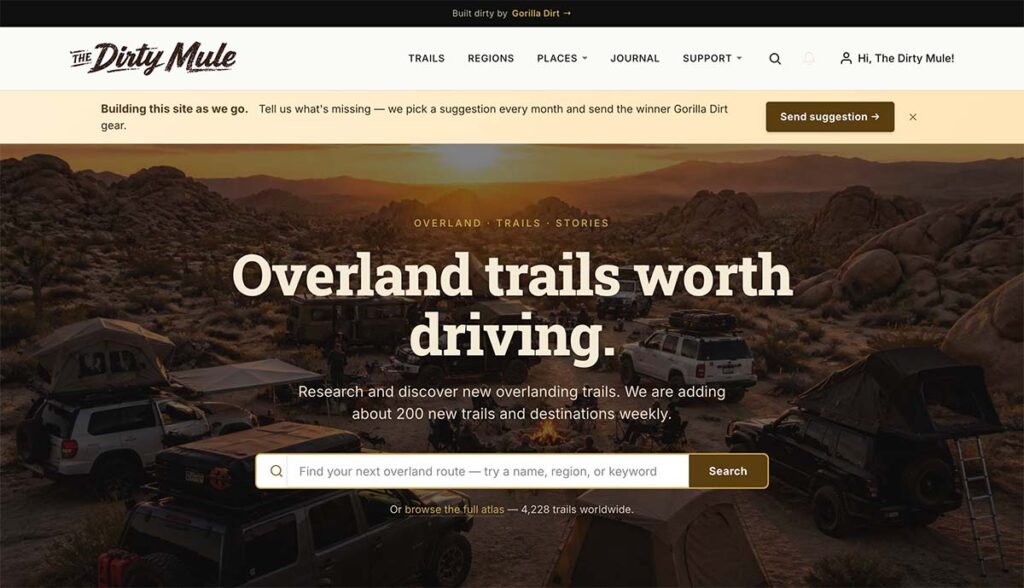
The Dirty Mule is an off-road trail atlas — 3,400+ trails across the country, each with specs, difficulty, interactive maps, and route details. It’s not a brochure site and it’s not a store: it’s a full data-driven web platform, and it’s ours. We built it, we run it, and it exists partly to prove a point people keep getting wrong — that WordPress can power a serious application when you build custom instead of stacking plugins. This is the engineering teardown.
The brief we gave ourselves
Build a trail atlas that can stand next to venture-backed apps in the same space — thousands of structured trail records, fast search and filtering, maps that work on a phone with one bar of service — on a bootstrap budget, on WordPress, maintainable by a very small team. The mission is simple: when someone asks where to wheel this weekend, be the answer. Everything below serves that sentence.
Architecture: a platform wearing a CMS
The site runs on a custom theme and one purpose-built plugin suite — a genuine application layer of 80+ PHP files handling everything a trail database needs: structured trail data, spec rendering, search and filtering across thousands of entries, user accounts, community systems, and admin tooling. The separation is deliberate and disciplined: the plugin owns the data and features, the theme owns presentation, so either can evolve without breaking the other. Hosting is managed WordPress on Kinsta, with a deployment routine (plugin, then theme, then cache) that keeps thousands of live pages consistent through hundreds of releases — the plugin alone has shipped well over two hundred versioned builds.
The trail pages: structured data, taken seriously
Every trail is a structured record, not a blog post: difficulty, length, elevation, seasonality, land manager, vehicle requirements — rendered into consistent spec tables and interactive Leaflet maps (with a fullscreen mode engineered to work even inside iOS’s browser quirks). Trails cite up to three labeled official sources, because off-road information has real consequences: a closed route presented as open can cost someone a vehicle, a fine, or worse. When a Rollins Pass historian wrote to correct details on one of our most-trafficked trails, the corrections went in — down to the elevation datum. That’s the editorial standard a trail database owes its users.
The structure pays twice: humans get scannable, trustworthy pages, and search engines — including AI answer engines — get exactly the kind of clean, specific, citable data they promote. “Best trails near [town]” queries are the platform’s front door, and the pages are shaped to win them.
Community as infrastructure: reports, suggestions, and Dirt Cred
A 3,400-trail database can’t stay accurate from a desk — so the users maintain it with us. Every trail page carries a public “report an inaccuracy” system with upvoting, so the most important corrections surface themselves; suggestions email the admin team instantly, and a pending-items counter sits right in the WordPress admin menu so nothing rots in a queue.
On top of that sits Dirt Cred, a full gamification system that turns contribution into status: eight tiers from Rookie to Silverback, achievements, time-windowed leaderboards, per-trail contributor credits, a Verified Wheeler distinction, and a weekly email digest that pulls people back. The admin side got equal care — contributor dossiers on demand, exclusion controls, the unglamorous moderation tooling that keeps a points system honest. Gamification isn’t decoration here; it’s the maintenance budget, paid in recognition instead of dollars.
Performance engineering at database scale
Thousands of data-heavy pages with maps is exactly where WordPress sites usually fall over, so performance is engineered, not hoped for: REST endpoint caching, self-hosted map assets instead of third-party dependencies, aggressive image optimization, and bot protection to keep scrapers from burning server resources meant for humans. Even operational quirks get first-class treatment — the hosting environment’s cron constraints are designed around rather than discovered in production. The result is a big database that browses like a small site, on trailhead cell service.
Content operations at scale
Maintaining 3,400 trails also took tooling nobody sees: an automated public-domain image pipeline pulling from Wikimedia and the National Park Service to enrich trail pages legally and at scale, and admin utilities like one-click duplicate-trail merging. These are the boring-sounding features that decide whether a large database is maintainable by two people or requires a staff — and “maintainable by a very small team” was in the brief.
What it proves
- WordPress can carry a genuine data platform — with a custom application layer, not a plugin pile
- Thousands of structured records can stay fast, on mobile, on weak connections
- Community systems can fund data maintenance — if the admin tooling keeps pace
- Editorial accuracy is a feature: sourced specs and published corrections build the trust rankings follow
- Two hundred–plus shipped releases on one platform: this is what long-term maintainability looks like
The stack, in one place
Platform: WordPress, custom theme + custom application plugin suite (80+ PHP files) · Hosting: Kinsta managed WordPress · Maps: Leaflet, self-hosted assets, mobile fullscreen · Data: 3,400+ structured trail records, labeled official sources, public correction system · Community: Dirt Cred gamification — tiers, achievements, leaderboards, weekly digest · Ops: REST caching, bot protection, automated image pipeline, duplicate merging, admin moderation tooling
Explore it live at thedirtymule.com. Like Gorilla Dirt, it runs on our own dime and our own time — it’s what “we build custom platforms” looks like when we’re the client. If you’ve got a data-heavy idea that everyone says needs a six-figure app build, this is the counterargument. We quote those flat, too.
