E-Commerce
Pressed by Sienna
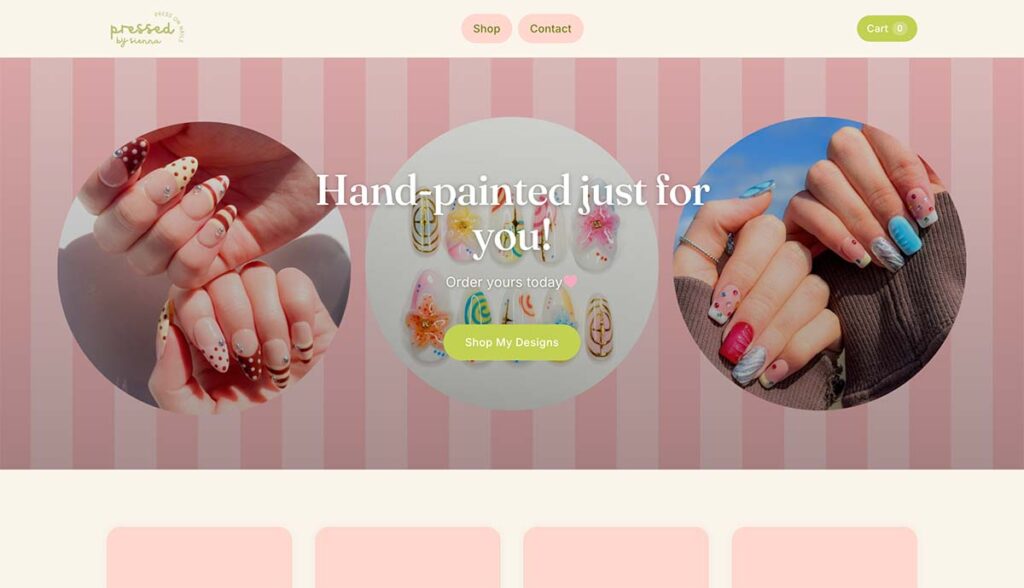
Pressed by Sienna makes handmade press-on nail sets — and handmade is the whole engineering challenge. Every set takes real hours of one person’s hands, which means the store can’t take unlimited orders like a warehouse brand. Standard e-commerce has no answer for that: every platform assumes infinite inventory or a simple stock count, and neither describes a maker’s calendar. So we built the answer ourselves. This is the teardown of a small store with one genuinely novel piece of engineering at its heart.
The brief
Build a store that sells like real e-commerce but respects the reality of a one-maker production schedule. It had to feel like the boutique brand it is — warm, personal, handcrafted down to the pixel — let customers configure sets properly (nail shapes and sizes aren’t an afterthought; they’re the product), and above all, never let demand bury the maker. Selling out should be a growth signal, not a customer-service crisis.
Architecture: a boutique build for a boutique brand
The site runs on a custom WordPress theme and a companion functionality plugin — the same disciplined separation we use on every build: the plugin owns the business logic, the theme owns the look, so either can evolve independently. And the look is entirely hers: a cream, blush, and deep-green palette with expressive serif headlines and clean body type, designed from scratch around the brand’s handcrafted feel. No generic shop template doing a boutique brand no favors — the site feels like the product, which for a brand this visual is half the sale.
Configuring the product: shapes and sizes done right
Press-on nails are a fitted product — shape and sizing are the difference between a delighted repeat customer and a return. The product experience is built around that: clear shape and size pickers integrated into the buying flow, so every order arrives with exactly what the maker needs to produce it and the customer needs to love it. Browsing got the same care, with clean category filtering that makes a growing catalog feel curated instead of cluttered.
The heart of the build: the capacity & waitlist system
Here’s the problem no platform has a checkbox for: a maker can produce a fixed number of sets per production window. Take more orders than that and every one of them ships late; close the store and revenue stops. So the store enforces capacity itself — orders are capped per window, and when the slots fill, the store doesn’t oversell and bury the maker. It opens a waitlist.
Customers join with one click and get notified the moment a slot opens. The maker’s schedule stays humane and every promised date stays keepable. And the business gains something most small makers never see: a running, measurable list of demand it hasn’t even served yet — proof of product-market fit you can read off a screen, and a ready-made audience for every restock. Sold out stops being lost revenue and becomes a marketing asset.
Built to run itself
Like every Gorilla Public build, the day-to-day lives with the owner, not with us: products, imagery, and content are managed in normal WordPress, capacity does its job automatically, and even small details like the footer copyright are owner-editable settings rather than code. Twenty-five theme releases and ten plugin versions in, the platform has grown with the brand — iterated, not rebuilt — which is what a maintainable custom build looks like from the inside.
What it proves
- Custom code solves the problems platforms don’t have a checkbox for — cleanly
- A one-maker business can run real e-commerce without breaking its own promises
- Capacity limits, built in honestly, turn sold-out into demand data and marketing
- Boutique brands benefit most from custom design — the site is the storefront
- Small store, small budget, dozens of shipped iterations: custom scales down, too
The stack, in one place
Platform: WordPress + WooCommerce, custom theme + companion functionality plugin · Design: bespoke brand system — cream/blush/green palette, expressive serif + clean sans type · Product experience: shape & size pickers, category filtering · The differentiator: order-capacity system with automatic waitlist and open-slot notifications · Operations: owner-managed content and settings, iterated across dozens of releases
Small business, one maker, real constraints — that’s exactly who custom builds are for. If your business has a problem the big platforms shrug at, that’s not a dead end. That’s a spec. We quote those flat.
