July 6, 2026
How to Get Your Social Media Posts Discovered: Keywords, Hashtags, and Brand Voice
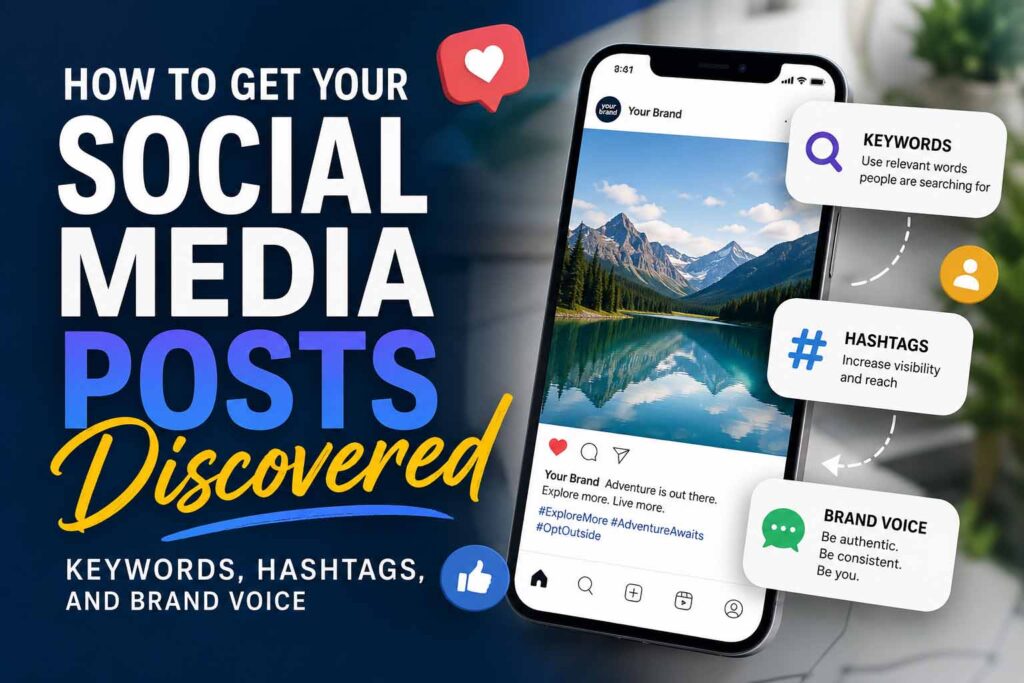
Here’s the uncomfortable truth about social media in 2026: posting is easy, being found is the whole game. Most small businesses post into the void — decent photos, a caption written in thirty seconds, a copy-pasted block of hashtags — and then wonder why nothing happens. Meanwhile, the businesses that get discovered aren’t luckier or better funded. They understand three things: how discovery actually works now, how to use the words people actually search, and how to sound like somebody instead of everybody.
This post covers all three, in the order they matter. It’s long on purpose — bookmark it, work through it, and your next month of posts will outperform your last six.
First, understand how discovery works now
Social platforms stopped being follower feeds years ago. Today they behave much more like search engines and recommendation machines. Two shifts matter for your business:
1. Most of your reach comes from people who don’t follow you
TikTok’s For You page, Instagram Reels and Explore, Facebook’s suggested content, YouTube’s recommendations — the platforms decide who sees your post based on the post itself, not your follower count. Every post is auditioned: shown to a small test audience, measured (did people stop scrolling, watch, save, share, comment?), and then shown to more people or quietly buried. That means every single post is a fresh chance to be discovered — and follower count matters less than it ever has. Great news for small businesses; terrible news for lazy content.
2. People search social media like they search Google
“Restaurants in Murphys.” “How to fix squeaky brakes.” “Press-on nails that last.” A huge share of younger customers run those searches on TikTok and Instagram before — or instead of — Google. Platforms have leaned in hard: they index your captions, your spoken words, your on-screen text, and yes, your hashtags, then serve your posts in search results for weeks or months. A post that performs for two days in the feed can keep pulling customers from search for a year.
Keywords: say what people search, where the platform can read it
Social SEO is real, and it’s simpler than website SEO. The platform can only match your post to a search if the searched words actually appear in your content. Most businesses fail this test by writing clever instead of clear.
Find your keywords the honest way
- Type your product or service into each platform’s search bar and note the autocomplete suggestions — those are real searches, ranked by volume, handed to you for free.
- Listen to customer language. Customers say “my check engine light is on,” not “diagnostic services.” They search “coffee that isn’t bitter,” not “low-acidity single origin.” Use their words, not your industry’s.
- Go local. For a local business, town and region names are your unfair advantage: “wedding photographer Murphys CA” has a fraction of the competition of “wedding photographer” — and the person searching it is ready to book.
Put keywords where the platforms actually look
- The first line of your caption. Lead with the search phrase, naturally: “The best time to visit Murphys wine tasting rooms is a Thursday — here’s why.” Front-loading matters both for indexing and because that’s all anyone sees before “…more.”
- Spoken words in video. Platforms transcribe your audio. Actually saying “how to keep press-on nails from popping off” in the first three seconds is a ranking signal and a hook at the same time.
- On-screen text. Text overlays get read by the algorithm too. A headline overlay in the first frame (“3 signs your brakes are wearing out”) does double duty.
- Your profile. The name field is searchable — “Sienna | Press-On Nails” beats a name alone. Your bio should say plainly what you do and where: “Custom cakes in Angels Camp & Murphys, CA.”
- Alt text. Instagram and Facebook let you write alt text on images. It’s an accessibility feature first, but describe the image honestly with your keyword (“handmade blue french-tip press-on nail set”) and it’s one more signal.
Hashtags: topic labels, not magic reach
Hashtags are the most misunderstood tool on social media, mostly because the advice is ten years stale. In 2016, stacking 30 hashtags genuinely pumped reach. Today, platforms have said the quiet part out loud: hashtags are primarily a way to tell the algorithm what your post is about — a categorization signal that supplements your caption keywords, not a reach hack that replaces them.
How to think about them
Imagine filing your post in a library. Hashtags are the labels on the folder: they help the platform route your content to people who’ve shown interest in that topic, and they make you findable when someone browses or follows the tag. That’s it. A post with perfect hashtags and boring content still dies in the audition; a great post with zero hashtags can still run. Labels don’t fix the book.
A simple structure that works
Use roughly 3 to 5 hashtags per post, drawn from four buckets:
- One broad topic tag — the big category: #coffeeroaster, #autorepair, #weddingphotography. High volume, high competition; you’re planting a flag, not expecting to rank.
- One or two niche tags — the specific thing in this post: #pourover, #brakerepair, #pressonnails. Smaller audiences, far higher intent. This is where discovery actually happens.
- One local tag — #murphysca, #calaverascounty, #goldcountry. Local customers browse local tags, and it reinforces your geography for local search.
- One branded tag — your business name or a signature tag you use on everything. Nobody searches it yet; that’s fine. It builds a browsable archive of your posts and gives customers a tag to use, which is free content for you.
What to stop doing
- The copy-pasted 30-tag block. At best it’s noise diluting your signal; at worst it reads as spam behavior to both the algorithm and the humans.
- Irrelevant trending tags. Tagging #superbowl on your nail sets confuses the categorization system that’s trying to help you and tanks your engagement rate when football fans scroll past.
- Giant-only tags. If every tag has 50M posts, your content is a raindrop in an ocean. Niche and local tags are where a small business can actually be seen.
- Hashtag-stuffed captions. Keep the caption human. Tags go at the end, or in the first comment — placement barely matters anymore; readability does.
Brand voice: sound like somebody
Keywords get you found. Voice gets you remembered — and followed, and chosen. Most small business accounts sound identical: same “We’re so excited to announce…”, same emoji clusters, same corporate-polite nothing. When every post could have been written by any business in town, you’ve given people no reason to remember yours.
Brand voice is just this: the consistent personality in your words. Not a logo, not a color palette — how you’d talk if your business were a person. And it’s a small-business superpower, because you can actually have one. A franchise has to sound committee-approved. You get to sound like you.
Define it in an afternoon
- Pick three words. Describe how you want to sound — not what you sell. “Rugged, honest, funny.” “Warm, expert, calm.” “Playful, bold, local.” If your three words could describe any business in your industry (“professional, quality, friendly”), dig deeper.
- Write a do/don’t say list. The fastest tool there is. A rugged outdoor brand: do say “built to take a beating,” don’t say “premium quality solutions.” A warm bakery: do say “pull up a chair,” don’t say “utilize our ordering platform.” Ten entries in each column and your voice is basically documented.
- Steal from your own mouth. How do you actually explain your product to a customer standing in front of you? Record yourself, transcribe it. That’s your voice — captions should sound like that, not like a press release.
- Decide your relationship to the reader. Are you the trusted expert, the friend who happens to know this stuff, the entertaining character? Pick one and hold it.
Keep it consistent — everywhere, from everyone
Voice compounds only if it’s consistent. Same personality in captions, replies to comments, DMs, and even how you handle a complaint — a distinct voice that vanishes the moment someone’s unhappy wasn’t a voice, it was a costume. If more than one person posts for you, the do/don’t list is what keeps Tuesday’s post from sounding like a different company than Monday’s.
Adapt the format per platform, never the personality. Shorter and punchier on X, more casual on TikTok, a bit fuller on Facebook — but the same somebody, everywhere. People should be able to recognize a post as yours with the logo covered. That’s the test.
Put it together: a pre-post checklist
Before anything goes live, run it through this. Thirty seconds, every post:
- Would my customer actually search for this topic?
- Is the search phrase in the first line of the caption?
- If it’s video: did I say the keyword out loud early, and is it on screen?
- 3–5 hashtags: one broad, one or two niche, one local, one branded?
- Does this sound like us — would it pass the logo-covered test?
- Is there a reason to stop scrolling in the first second?
- Does it tell people what to do next — comment, save, visit, order?
- Alt text written on images?
Common questions
How long until this starts working?
Search-driven discovery compounds slowly, then suddenly. Expect little for the first few weeks while you build a base of findable posts, with individual posts occasionally popping. By month two or three, older posts pulling steady search traffic becomes your floor. This is a system, not a lottery ticket — the payoff is that it keeps working while you sleep.
Which platform should a small local business focus on?
The one where your customers actually search, done well — not four platforms done badly. For most local businesses that’s Instagram plus Facebook (and Google Business Profile posts, which almost nobody does and which show up directly in Maps). If your customers skew under 35 or your product is visual, add TikTok. Depth beats breadth every time.
Do hashtags still matter at all, then?
Yes — as categorization and browsability, which is worth the ten seconds it takes to add 3–5 good ones. What’s dead is hashtags as a growth strategy on their own. Caption keywords and content quality moved into that job.
Should I use AI to write my captions?
As a drafting assistant, sure. As a replacement for your voice, no — default AI writing sounds like everyone else’s default AI writing, which is the exact opposite of the point of brand voice. If you use it, feed it your do/don’t list and edit until it passes the logo-covered test.
How often should I post?
As often as you can maintain quality — for most small businesses that’s 3–4 times a week, not 3 a day. One searchable, on-voice post beats five throwaways, because every weak post is a failed audition that teaches the algorithm your account is skippable.
The short version
Social media discovery in 2026 runs on three things you control completely: make posts that answer what your customers already search, put those words where the platform can read them; use a handful of deliberate hashtags as topic labels, not confetti; and sound like somebody — consistently enough that people recognize you before they see your name. None of it requires a budget. All of it requires giving a damn, post after post. That’s the whole trick.
Rather have someone run this playbook for you — the content, the keywords, the voice, the whole social presence? That’s what we do for small businesses, at a flat monthly fee. Tell us about your business and you’ll hear back within one business day.
