July 6, 2026
The One Idea That Ties Your Website, Google, Ads, and Social Media Together
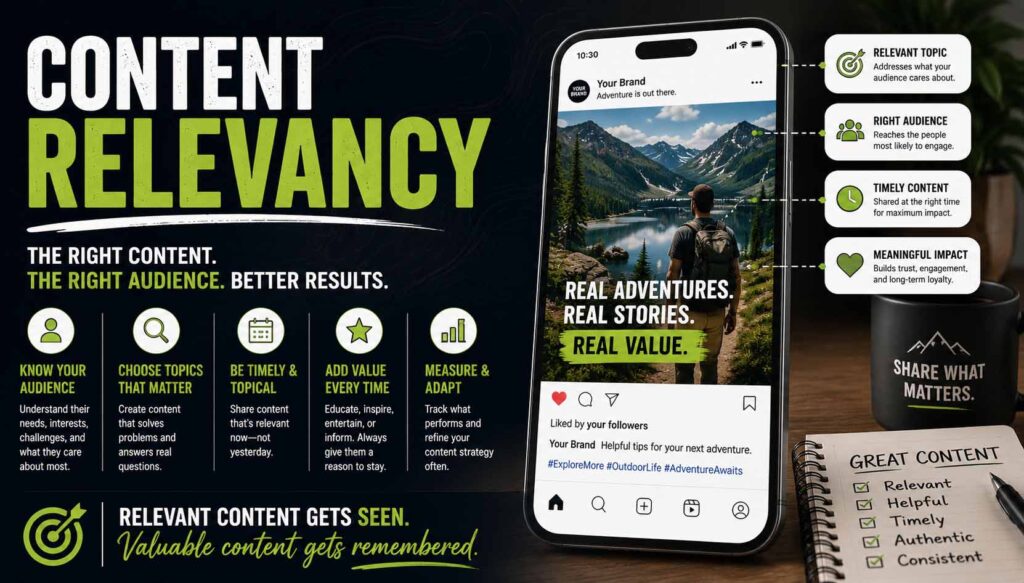
Small business marketing feels like six different jobs: keep the website updated, do something about SEO, run some ads, post on social, sound like a brand while doing it. Six channels, six sets of advice, six things to feel behind on.
Here’s the secret that makes it manageable: all of it is the same job. Every one of those channels — Google’s rankings, the price you pay for ads, what social media shows people, whether a visitor becomes a customer — is scoring the exact same thing: relevance. How well your content matches what a specific person is looking for at the moment they’re looking. Understand that one idea deeply and every channel starts making sense. Ignore it and you pay for it — on ads, quite literally, in dollars.
What relevance actually means
Relevance isn’t “quality.” It isn’t “professional.” Plenty of beautiful, well-written content is completely irrelevant. Relevance is a match between three things:
- What the person wants — their question, problem, or intent (“brake repair near me,” “gift for a coffee snob,” “why is my website slow”).
- The words they use to express it — customer language, not industry language.
- What your content actually delivers — does the page, post, or ad answer that want, specifically, or does it answer something adjacent while gesturing at everything?
Every platform has built elaborate machinery to measure this match, because their business depends on it — Google keeps users by serving relevant results, Meta keeps users by showing relevant content. Your job isn’t to trick that machinery. It’s to give it an easy yes.
Relevance and your website: one page, one intent
The most common small-business website mistake is the everything page — one Services page listing nine different things you do in nine paragraphs. It feels efficient. To a search engine, it’s a shrug: a page that’s 11% about each thing is highly relevant to nothing.
Relevant websites are built the opposite way: a dedicated page for each distinct thing customers search for. An auto shop doesn’t need one Services page — it needs a brake repair page, an oil change page, a check-engine diagnostics page, each speaking that intent’s language, answering that intent’s questions, with that intent’s call to action. This is why a serious local-business site has fifteen or twenty landing pages instead of five: not padding, but a relevance match waiting for every search that matters.
Two more website relevance rules that pay for themselves:
- Say the thing plainly, early. The page about brake repair in Modesto should say “brake repair in Modesto” in the headline, the first paragraph, and the page title — not because of keyword magic, but because both Google and a scanning human decide in seconds whether they’re in the right place.
- Structure for machines that answer questions. AI search — Google’s AI results, ChatGPT, the rest — is now part of how customers find businesses. Those systems cite content that’s clearly organized, factually specific, and answer-shaped: real headings, direct sentences, schema markup underneath. Relevance now includes being quotable.
Keywords: the customer’s words, everywhere, consistently
Keywords get treated like an SEO chore. They’re bigger than that: keywords are the vocabulary of your customer’s intent, and they belong in every channel, not just meta tags. The bakery’s customers search “custom birthday cakes,” so that exact phrase belongs on the website page, in the Google ad, in the Instagram caption, and on the Google Business Profile. Same words, every surface.
Where businesses go wrong is translating themselves into industry-speak: the customer searches “car won’t start,” the shop’s website says “comprehensive electrical diagnostic solutions.” Both describe the same service; only one is relevant, because relevance is measured in the searcher’s language, not yours. Finding these words isn’t a paid-tool project — your customers hand them to you in every phone call, review, and search-bar autocomplete. Write them down. That list is the most valuable marketing document you own.
Relevance and Google: rankings are a relevance score
Strip away the mystique and Google’s organic ranking is a relevance engine with a trust filter. For any search, it asks: which pages most completely satisfy this intent (relevance), and which of those can we trust (authority, experience, a site that works on phones and loads fast)? You influence the trust side slowly. You influence the relevance side this week — by building the intent-matched pages above, using customer vocabulary, and answering the actual question instead of talking about yourself for four paragraphs first.
And the local layer doubles it: for “near me” searches, relevance includes geography. Your city and service area belong in your content, your Google Business Profile categories, and your reviews. A perfectly optimized page that never says where you are is irrelevant to the searches that pay your rent.
Relevance and digital ads: the only channel that bills you for irrelevance
Here’s where relevance stops being abstract and becomes a line item. Google Ads scores every ad with a Quality Score built substantially on relevance — how well your ad matches the search, and how well your landing page matches your ad. Meta runs equivalent relevance diagnostics on every ad. And both platforms do the same thing with the score: relevant ads pay less per click and win better placement; irrelevant ads pay a premium for worse positions. Two businesses can bid on the identical keyword and one pays half as much — because their ad and page actually match the search.
The mechanism to obsess over is message match — the chain from search to sale:
- Someone searches “brake repair Modesto.”
- Your ad headline says “Brake Repair in Modesto — Same-Week Appointments.”
- They land on your brake repair page — not your homepage — which repeats the promise and shows the button.
- They call. That’s it. That’s the whole machine.
Every broken link in that chain costs real money: an ad sending brake-repair searchers to a generic homepage bleeds Quality Score, raises your cost per click, and loses the visitor who came for one thing and got a menu. This is also why ads and website can’t be run as separate projects by separate vendors who don’t talk — the ad platform is grading them as one system, because to the customer, they are.
Relevance and social media: discovery is a relevance audition
Social platforms audition every post: show it to a small test audience, measure whether those people found it relevant — stopped, watched, saved, shared — and distribute accordingly. Meanwhile the same platforms index your captions, spoken words, and on-screen text for search. Both systems are relevance engines, which means the playbook is the same one running through this whole post: make content about what your customers are actually looking for, in the words they use, labeled with a handful of deliberate hashtags so the platform knows where to file it. We wrote a full guide to social discovery, keywords, and hashtags — the point here is that it isn’t a separate discipline. It’s the same relevance job on a different surface.
The brand thread: relevance you can recognize
So where does brand fit? Brand is what makes all this relevance compound instead of scatter.
Think about what a customer actually experiences: they see your Instagram post, later search Google and hit your ad, click through to your landing page, maybe read your reviews, then call. To you those are four channels. To them it’s one conversation with one business — and if the voice, the promise, and the language shift at every step, trust leaks out at every seam. If the rugged, plain-spoken post leads to a corporate-buzzword website, something feels off, even if the customer can’t name it. Relevance isn’t only matching the search; it’s matching yourself, consistently, until people recognize you.
That consistency is also mechanically valuable. One positioning (“honest brake repair, straight prices, Modesto”) repeated across your site, ads, social, and Google Business Profile means every channel reinforces every other: the ad performs better because the landing page matches; the social post converts better because the website sounds like the person they followed; the Google result gets clicked because they’ve seen the name three times this month. Scattered messaging makes six channels compete for coherence. A brand makes them stack.
The relevance audit: run your own business through it
- Does each service you offer have its own page, or one everything-page shrug?
- Do your pages use the words customers actually search, or industry-speak?
- Does your site say your city and service area where it counts?
- Does every ad send its click to a page that repeats the ad’s promise?
- Would your Quality Scores / ad relevance diagnostics embarrass you? Have you looked?
- Are your social posts about what customers search, or what you felt like posting?
- Same voice and same core promise on your site, ads, social, and GBP?
- Could a customer describe your business the same way after visiting any single channel?
Common questions
Isn’t this just “do SEO” wearing a different hat?
SEO is one application of it. The point is that the same principle prices your ads, drives your social distribution, and decides whether visitors convert — and that treating those as four unrelated projects is how businesses end up with four mediocre channels instead of one coherent system. Relevance is the strategy; SEO, ads, and social are surfaces.
Where should I start if everything above needs work?
The website — specifically, dedicated pages for your top three or four money services, written in customer language. Every other channel points there: ads land on those pages, social profiles link to them, Google ranks them. Fixing the destination first makes every channel you fix afterward work better immediately.
How do I know what my customers actually search?
Free sources, in order: Google’s and each platform’s search autocomplete; the exact phrases customers use on the phone and in reviews; Google Business Profile’s performance report showing real searches that surfaced you; and Google Search Console once your site has some history. Paid keyword tools are nice-to-have; listening is the requirement.
Does relevance mean I can only ever post and write about my services?
No — it means everything should be relevant to your customer, which is bigger than your service list. The coffee roaster writing brew guides, the auto shop explaining warning lights, the photographer with venue tips: all highly relevant to their customers, none of it a sales page. Off-limits isn’t “not about us.” Off-limits is “not about them.”
How long before relevance work shows results?
Ads respond fastest — message-match fixes can move cost per lead within weeks. Social discovery builds over one to three months. Organic Google is the slow burn: a few months to a year depending on competition. Which is the argument for doing it as one system: the fast channels pay the bills while the slow ones compound.
The short version
Google rankings, ad prices, social reach, and conversion rates are four scoreboards measuring one game: how well your content matches what a real person wanted, in their words, at their moment — from a business that sounds like the same business everywhere they meet it. Build a page per intent. Use the customer’s vocabulary. Match every ad to its landing page. Post about what they’re searching for. And hold one voice through all of it. That’s not six marketing jobs. It’s one, done with a straight spine.
This is the system we build for small businesses — website, SEO, ads, and social as one relevance machine, for a flat monthly fee. Tell us about your business and you’ll hear back within one business day.
