

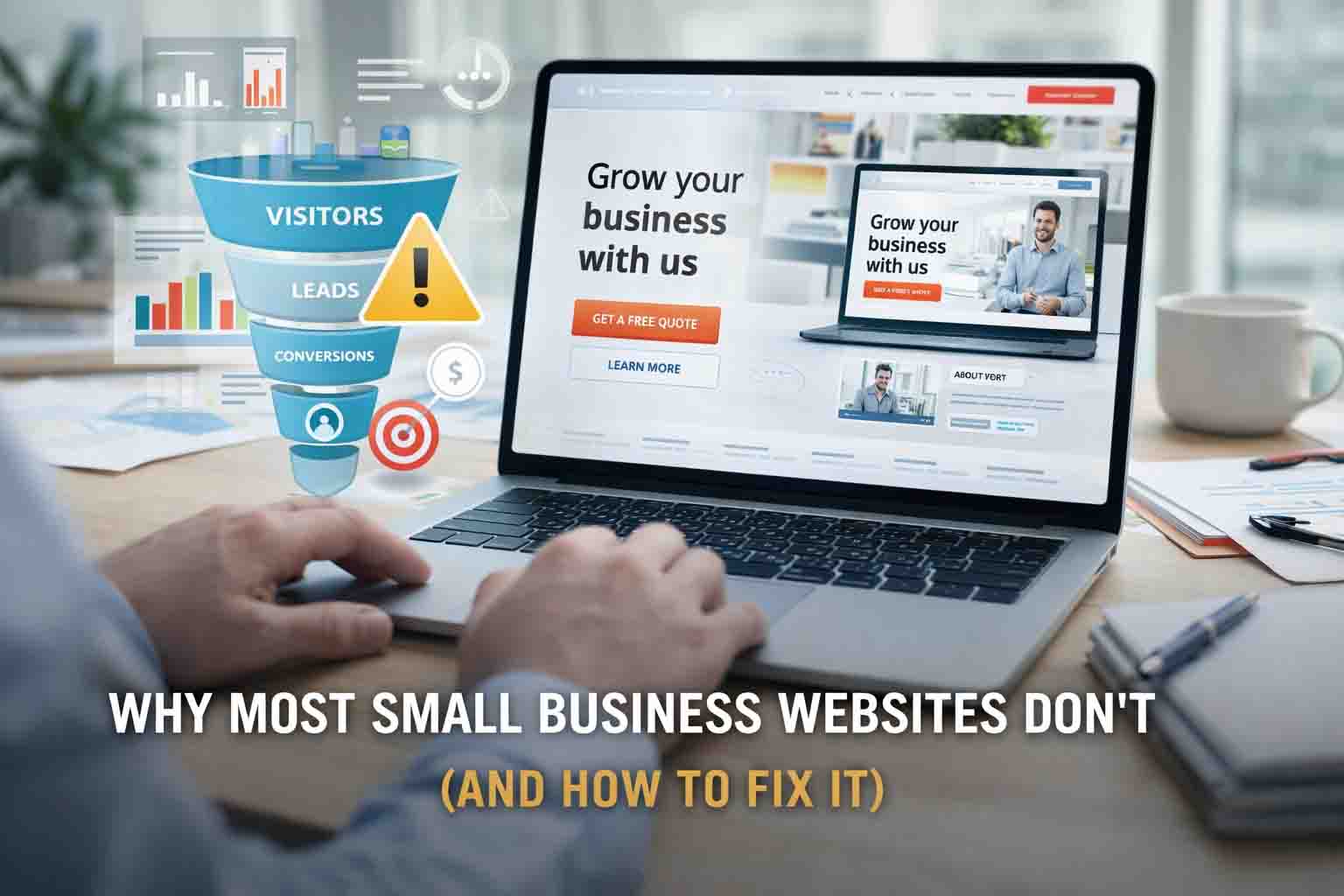
Why Most Small Business Websites Don’t Convert (And How to Fix It)
Your website might look good. It might load fast. It might even get traffic. But if it’s not generating leads or sales, it’s not doing its job.
Most small business websites don’t convert because they were built to look professional, not to perform strategically. Design alone does not drive revenue. A high-converting website is not decoration. It is infrastructure. If your website isn’t producing customers, it is costing you money.
What Does Website Conversion Actually Mean?
A conversion happens when a visitor takes action. That action might be filling out a contact form, booking an appointment, requesting a quote, calling your business, or making a purchase. Traffic alone does not grow a business. Conversions do. If people are visiting your site but not taking action, you do not have a traffic problem. You have a conversion problem.
No Clear Call to Action
One of the biggest reasons small business websites fail is a lack of clarity. Visitors should never have to guess what to do next. Every page should guide them toward a specific action.
If your website does not clearly direct visitors to book, call, schedule, or request something, you are leaving conversions on the table. Vague buttons and scattered options create hesitation. Clear direction creates momentum. Clarity converts.
Messaging That Focuses on You Instead of the Customer
Many small business websites begin with a history lesson. They talk about years in business, company values, and internal achievements. While those things matter, they are not what visitors care about first.
Customers arrive with a problem. They want to know if you can solve it. A strong homepage immediately answers who you serve, what problem you solve, and what outcome you deliver. When your messaging centers on the customer instead of your company, engagement increases and conversions follow.
A Weak or Confusing Value Proposition
If a visitor lands on your website and cannot understand what you do within five seconds, they leave. Attention online is short. Confusion kills momentum.
Your value proposition must be clear, specific, and outcome-driven. It should communicate the transformation you provide, not just the service you offer. Clever headlines may sound impressive, but clarity always outperforms creativity when it comes to conversion.
Poor Mobile Experience
More than half of website traffic comes from mobile devices. If your site loads slowly on a phone, forces users to zoom in, or makes forms difficult to complete, you are losing opportunities every day.
Mobile optimization is no longer optional. It is foundational. A website that performs well on desktop but struggles on mobile is incomplete.
Slow Load Times
Speed directly impacts both SEO and conversions. Studies consistently show that visitors abandon websites that take more than a few seconds to load.
Oversized images, cheap hosting, excessive plugins, and unoptimized code can all drag performance down. A fast website builds trust and professionalism. A slow one builds frustration and doubt.
No Funnel or User Journey
Most small business websites are structured like digital brochures. They provide information, but they do not guide visitors through a logical path.
A high-converting website moves visitors through a sequence. It identifies the problem, presents the solution, builds trust through proof, addresses objections, and then clearly invites action. Without this structure, users wander. And wandering users rarely convert.
Lack of Trust Signals
Trust is a deciding factor in whether someone takes action. If your website lacks testimonials, case studies, reviews, or clear contact information, visitors hesitate.
People want reassurance that others have worked with you and achieved results. Real photos, authentic testimonials, and visible proof of performance increase confidence and reduce friction.
No Tracking or Ongoing Optimization
Many small business owners launch a website and never revisit it. They do not measure conversion rates, track button clicks, analyze user behavior, or test improvements.
Conversion optimization is not a one-time event. It is an ongoing process of measuring, refining, and improving. Without data, improvement is guesswork.
What High-Converting Websites Do Differently
Websites that generate consistent leads and sales are built intentionally. They combine clear messaging with strong calls to action. They prioritize mobile performance and speed. They guide users through a structured journey and support claims with proof. Most importantly, they are measured and refined over time.
Conversion is not about flashy design trends. It is about engineering a clear path from visitor to customer.
The Bottom Line
If your website is not generating leads or sales, it is not fulfilling its purpose. The issue is rarely traffic alone. More often, it is structure, clarity, speed, trust, or strategy.
The good news is that conversion problems are fixable. With the right adjustments, even small improvements can significantly increase results without increasing advertising spend.
Your website should be your hardest-working employee. If it is not, it may be time to rebuild it with strategy in mind.
Ready to Improve Your Website Performance?
If your website is underperforming, we can help you identify what is holding it back and build a system designed to convert.
Schedule a free strategy call and let’s turn your website into a customer-generating asset.
)